Showing posts with label river. Show all posts

Monday, May 11, 2015

157th Anniversary of Minnesota Statehood


157 years ago, Minnesota became the 32nd state of the United States on May 11, 1858. It first became a territory of the United States in 1849. Then it submitted an application for statehood to President James Buchanan in January, 1858. However, distracted from a controversy about statehood of Kansas, Congress did not act on the application for several months before finally approved it. The state was created from the eastern half of the Minnesota Territory and part of the Wisconsin Territory. The name "Minnesota" was originated from a Dakota word meaning "clear blue water." The state is known as the "Land of Ten Thousand Lakes" due to its large number of lakes.

Postcard US-2269166 from Minneapolis, MN shows Minnehaha Falls, one of the most photographed sites in Minnesota with 850,000 visitors every year, at Minnehaha Park in Minneapolis, Minnesota. The park was designed by landscape architect Horace W.S. Cleveland in 1883, and was added to the National Register of Historic Places in 1969 as the Minnehaha Historic District.

Tuesday, March 10, 2015

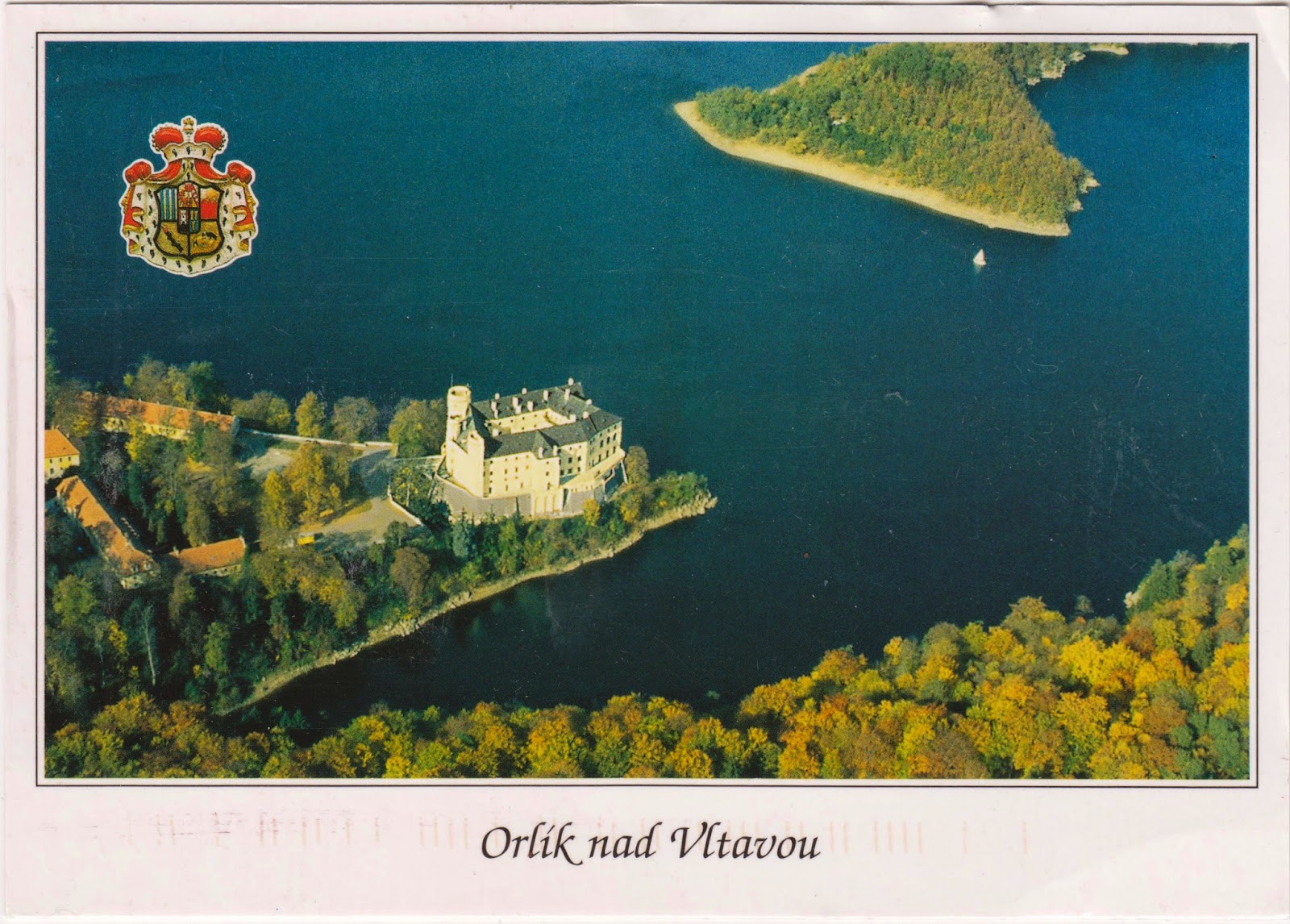
Orlík nad Vltavou

Postcard CZ-600263 from Czech shows Orlík nad Vltavou, a village in the South Bohemian Region of the Czech Republic. According to Wikipedia, the village was formerly called Staré Sedlo, named after the castle. In Czech, "nad Vltavou" means "upon the river Vltava" and both the castle and the village are located on the left river bank, on the shores of the Orlik reservoir as a result of the construction of Orlík Dam. The Orlík Castle, standing right next to the water, is surrounded by a huge park and a game preserve. It belongs to the House of Schwarzenberg, a Bohemian and Franconian aristocratic family, but it is open to the public on most summer days.

Friday, February 13, 2015

Burg Giebichenstein und die Giebichensteinbrücke


Postcard DE-3903996 from Germany shows Giebichenstein Castle and the Giebichensteinbrücke bridge in Halle (Saale), an economic and educational center in eastern Germany, located in the southern Saxony-Anhalt state.

Giebichenstein Castle, seen on the right on the postcard, was a royal residence of Otto I, Holy Roman Emperor in the 9th century. It is used by the Kunsthochschule Halle (Academy of Arts) of the Burg Giebichenstein Art School.

The Giebichensteinbrücke bridge, also known as Kröllwitzer bridge, is one of three Saale River crossings in Halle, located in the north part of the city below Giebichenstein Castle. The Giebichensteinbrücke bridge in its current form was built between 1926 and 1928 as a replacement for a steel bridge with large truss arch from 1892. The bridge's main arch was blown up during the final days of World War II on April 14, 1945. It was re-built in 1949 and renovated from 1993 to 1995.

On February 13, 1990, an agreement was announced on a two-stage plan to reunite Germany.

Friday, January 23, 2015

Wuhan by Ferry


Postcard CN-1520549 from China shows people taking ferries to cross the Yangtze River in Wuhan, Hubei Province, China. Wuhan (武汉), the capital of Hubei province and the most populous city in Central China, is located at the intersection of the middle reaches of the Yangtze and Han rivers, consisting of the conglomeration of three cities, Wuchang, Hankou, and Hanyang.

Those three cities face each other across the rivers and are now linked by bridges, including one of the first modern bridges in China. Ferries were the only transportation to cross the rivers before the Wuhan Yangtze Great Bridge opened in 1957. Even after the Metro Line 2, the first Metro line crossing through Yangtze River, opened on December 28, 2012, ferries remain a best choice for going directly across the Yangtze River since it's inexpensive and quick, and you can take your bicycle to the ferry for a nominal fee.

In addition, it's a scenic ride to see the rivers and skylines of the three cities. Many ferry terminals for the more than dozen ferry lines are located by the Snake Hill in Wuchang where the Yellow Crane Tower (黄鹤楼), a historic tower first built in 223 A.D., overlooking the Yangtze River.

Monday, December 29, 2014

Shigar Valley, Skardu, Pakistan


Postcard PK-3925 from Pakistan shows a bird-eye view of the Shigar Valley in northern Pakistan that is associated with the Shigar River. A gateway to the high mountains of the Karakoram, the valley stretches about 170 km from Skardu to Askole in a remote and largely inaccessible area. There are several villages in the valley: the town of Shigar being the largest and Askole being the last settlement that is closest to yet still quite far from the high mountains. The Shigar Valley is known for mining a variety of gemstones.

Sunday, December 28, 2014

Pangandaran, West Java, Indonesia


Postcard ID-120808 from Indonesia shows Pangandaran, West Java, Indonesia, a popular tourist destination known for its beach and surfing activities located on the southern coast of the island of Java.

It is a gateway to to Green Canyon (Cujang Taneuh) where visitors can hire a boat from the river harbor on the highway 1 kilometer before the turn-off to Batu Karas for a cruise along the emerald-green river in the jungle to a waterfall and a beautiful canyon.

In the news today, AirAsia Flight 8501 from Surabaya, Indonesia to Singapore vanished Sunday morning local time over the Java Sea. The expanded search so far has yet to turn up any trace of the Airbus A320. Located about 600 kilometers to the east of Pangandaran, Surabaya, capital of the province of East Java, is the second-largest city in Indonesia.

Thursday, November 6, 2014

Bern, Switzerland


Postcard CH-214914 from Switzerland shows a satellite image of the city of Bern,  the Bundesstadt or de facto capital of Switzerland. With a population of 137,980 as of 2013, Bern is the 4th most populous city in Switzerland with its metropolitan area of more than  660,000 residents.

The insert on the right shows an aerial view of the historic old town in the center of Bern, on the west of the boundaries of the peninsula surrounded by the River Aare, where the river forms the renowned “Aare loop” and the water temperature never reaches more than 20°C or 68°F. The medieval city center was recognized as a UNESCO Cultural World Heritage Site in 1983.

Wednesday, October 22, 2014

Love Locks and the Pont des Arts


Postcard SG-157009 from Singapore shows a loving couple at the Pont des Arts, a pedestrian bridge which crosses the River Seine in Paris, France. It was first built between 1802 and 1804, under the reign of Napoleon I, at the present location as the first metal bridge in Paris. Listed as a National Historic Monument on March 17, 1975, the Pont des Arts is also part of the World Heritage Site "Banks of the Seine" in Paris, recognized by UNESCO in 1991.

The bridge has been known for those love locks attached to the railing since 2008. Couples engrave their names on the padlocks and throw the keys into the Seine river after locking them in place as a gesture of committed love. However, as the number of locks became overwhelming, city officials in Paris started to remove some lock-laden railings and replace them with special glass panels in September, 2014. The Mayor's Office in Paris launched a #lovewithoutlocks campaign to encourage people to take "selfies" instead of leaving love locks.

Friday, September 19, 2014

Thus Things Flow Away Day and Night


I went to a yoga class last night. At the end of the session, the instructor asked us to grab a partner and tell each other the life stories of ourselves in 3 minutes. That reminds me a quote by Confucius, an ancient Chinese philosopher. He once pondered by a stream: "逝者如斯夫! 不舍昼夜," meaning "the passage of time is just like the flow of river that goes on day and night."

Outgoing postcard US-2995483 to Palo Alto, CA shows a bear in meditation by a river.

Monday, July 14, 2014

Die Moselschleife


Postcard DE-3315959 came from Germany today with a view of the Moselle River from Calmont near Bremm, Germany. As a left tributary of the Rhine, the Moselle River flows through France, Luxembourg, and Germany. Its watershed also contains a small portion of Belgium through its tributary the Sauer and the Sauer's tributary the Our.

The Moselle River valley is well known for its beautiful scenery and the excellent grape and wine production. Moselradweg, the 311-km or 193-mi long cycleway that connects Metz, France to Koblenz, Germany, runs through Bremm.


In the news today, Germany will issue a World Cup victory postage stamp, in 0.60 euros, on Thursday July 17, 2014. Five million stamps, marked “Germany Football World Champion 2014”, were printed before the 2014 FIFA World Cup final game.

Asked what would have happened to the stamps if Germany had lost, a finance ministry spokeswoman replied: “We always firmly believed the German team would win.” I love the conviction.

Monday, June 2, 2014

Yellow Crane Tower

Postcard CN-988823 from China shows a night view of the Yellow Crane Tower (黄鹤楼), a historic tower first built in 223 A.D., overlooking the Yangtze River from the Snake Hill in Wuhan, Hubei, China.

Hubei (湖北), a province in the easternmost part of central China, covers the territory of the ancient state Chu (楚) during the Warring States period of the Zhou Dynasty, where its minister and poet Qu Yuan (circa 340–278 B.C.) called home. Once served in high offices, Qu Yuan was banished for his opposition to the alliance with the powerful state of Qin, and accused of treason. Qu Yuan was very productive and wrote a lot of poetry during his exile. Twenty-eight years later since his exile, Qin captured Ying (郢), the capitol of Chu. With his early prediction validated, Qu Yuan threw himself into the Miluo River (汨罗江), a branch to the Dongting Lake in the Yangtze River watershed, in protest by suicide.

The legend says that local people, who admired him, raced out in their boats to save him, which became the origin of dragon boat races. In despair, they also dropped sticky rice balls into the river to distract fish so that those fish would not bite Qu Yuan's flesh. Those rice balls thus became the origin of zongzi. The date of his death has been commemorated as Duanwu Fesitival or Dragon Boat Festival to celebrate Qu Yuan's patriotism, which occurs on the 5th day of the 5th month of the traditional lunar calendar. The date varies from year to year on the Gregorian calendar. In 2014, it falls on June 2.

Thursday, April 3, 2014

Nizhny Novgorod


Postcard RU-2493226 from Russia shows a magnificent cityscape of Nizhny Novgorod. Also known as Nizhny for short, it is the fifth largest city in Russia with a population of more than 1.3 millions as of 2003. From 1932 to 1990, the city was known as Gorky (高尔基城), named after the famous writer Maxim Gorky who was born there.

As the administrative center of Nizhny Novgorod Oblast, the city is an important economic, transportation and cultural center for the vast Volga-Vyatka economic region in Russia.

Friday, February 21, 2014

Dniester Canyon, Ukraine


Postcard UA-951602 from Ukraine shows Dniester Canyon, a 250-km or 155-mile river segment of the Dniester River from the mouth of Zolota Lypa River to the mouth of Zbruch River. According to Wikipedia, Dniester River is the second largest and the most ecologically clean river in Ukraine.

Similar to the Colorado River below the Glen Canyon Dam in the United States, Dniester Canyon is partly flooded by reservoir waters. While the water depth can reach up to 50 meters, the canyon valley has its depth varied from 80 to 200 m or from 260 to 650 ft. Its original and unique geological, botanical, archaeological, and hydrological nature earned its reputation as one of seven natural wonders in Ukraine. Dniester Canyon was recognized the National Nature Park on February 3, 2010.


Monday, November 18, 2013

William J. Clinton Presidential Center, Little Rock, Arkansas


Traveling Postcard US-2452513 to Ukraine shows the William J. Clinton Presidential Center and Park in Little Rock, Arkansas, which  includes the Clinton Presidential Library, the offices of the Clinton Foundation, and the University of Arkansas Clinton School of Public Service.

It is located on a 69,000-square-meter or 17-acre land by the Arkansas River and Interstate 30. The main building extends towards the Arkansas River, exemplifying Clinton's campaign promise of "building a bridge to the 21st century." The Clinton Presidential Center was dedicated nine years ago on November 18, 2004. The 1899 Rock Island Railroad Bridge across the Arkansas River, shown on the left of the postcard, was originally leading to Choctaw Station. It has been converted into a pedestrian bridge connecting to North Little Rock and renamed as the Clinton Park Bridge. The dedication ceremony was held on September 30, 2011, and the bridge was opened to the public on October 2, 2011.

The photo on the postcard was taken on April 10, 2006 When I was driving cross-country from West Palm Beach to Las Vegas. The postcard, mailed along with more than a dozen other cards including some private swaps, has traveled more than 30 days. All those cards mailed on that day appear lost in the mail, since none of the cards was received. I am in the process of  re-sending the replacement. So far, one replacement card was received. Unfortunately, some of those postcards are unique and do not have duplicates.

Tuesday, October 15, 2013

First Bridge of the Yangtze, Wuhan, China


Postcard US-2293208 to Belarus shows the Wuhan Yangtze Great Bridge ( 武汉长江大桥) in Wuhan, Hubei Province, China with a photo taken on October 1, 2007. The double-deck road and rail bridge was the first bridge across the Yangtze River, the longest river in Asia and the third-longest in the world. It opened to public traffic fifty six years ago on October 15, 1957.

The Wuhan metropolis is an amalgamation of three cities located at the confluence of the Yangtze River and one of its branches: the Han River: Wuchang is located on the southern bank of the Yangtze; Hanyang is on the northern bank of the Yangtze and the west bank of the Han; and Hankou sits on the northern bank of the Yangtze and the eastern bank of the Han. Wuhan lies in the heart of Central China and has been a transportation hub between Beijing, the political and culture center in the north and the trading ports of Guangzhou and Hong Kong in the south. The Beijing-Wuhan railway line went into full service in 1906, followed in 1936 by the Wuhan-Guangzhou railway line. Before the bridge was built, train cars travelling between northern and southern China had to be ferried on barges over the Yangtze River, a laborious and time-consuming practice. Plans for the bridge's construction were first made in 1910; and four exploratory surveys were made between 1913 and 1948 for site selection. However, the construction did not start until 1955 due to economic constrains and the combination of World War II and the Chinese Civil War. The construction lasted for two years and was assisted by a 28-person delegation of engineers from the then Soviet Union.

The bridge extends 1.6 kilometers or 1 mile from Turtle Hill in Hanyang, on the northern bank of the Yangtze River, to Snake Hill in Wuchang, on the southern bank of the Yangtze River. The upper level of the bridge has four lanes for two-way automobile traffic while the lower level is a double-track railway on the Beijing-Guangzhou railway line.

Since then, there have been 60 bridges and 3 tunnels built by September 2013 over the 2,884 km or1,792 m main stretch of the Yangtze River, representing a broad array of bridge designs and significant achievements in modern bridge design and engineering.

Monday, August 19, 2013

Minsk, the City and the Rivers

Postcard BY-982349 from Belarus arrived today with a panorama view of the Trinity Suburb and the Svislach river embankment. Minsk is the capital of Belarus. With a population of 2,002,600 in 2013, it is the largest city in Belarus. The earliest history of Minsk dates as far as the 11th century. The settlement developed on the Svislach and Nyamiha rivers.

Sunday, July 21, 2013

Annisquam Lighthouse in Gloucester, Massachusetts

Annisquam Lighthouse in Gloucester, MA
I received a postcard PL-732364 from Poland a few days ago. Interestingly, it features the historic Annisquam Lighthouse on Wigwam Point in Gloucester, Massachusetts, USA.

The original lighthouse was a 12 m or 40 ft  wooden tower built in 1801. It was replaced by an octagonal wooden tower of the same height in 1851. The current cylindrical brick lighthouse was built in 1897.

The lighthouse was added to the National Register of Historic Places in 1987. It is still an active aid to navigation. However, there is no public access. Visitors may view the lighthouse across the Annisquam River from Wingaersheek Beach in Gloucester; or from a commercial cruise.