Showing posts with label UNESCO. Show all posts

Wednesday, May 25, 2016

Constitutional Convention in 1787

Today is the 229th anniversary of the opening of the Constitutional Convention in Philadelphia, PA. Postcard US-4013590 to Germany was a 1987 14¢ postal card, the first of three issues by USPS commemorating the bicentennial of the Constitution.

The card bears a multi-colored 14-cent pre-printed stamp on its upper right corner, depicting Independence Hall as it appeared in 1787. Built in 1753, the building now known as Independence Hall was the colonial legislature and later Pennsylvania State House for the Province of Pennsylvania. It was the principal meeting place where both the United States Declaration of Independence (July 4, 1776) and the United States Constitution (September 17, 1787) were debated and adopted. Recognized as a UNESCO World Heritage Site in 1979, it is now the centerpiece of the Independence National Historical Park in Philadelphia, Pennsylvania.

The multi-color design also shows five convention delegates: George Mason of Virginia, Gouverneur Morris of New York, James Madison of Virginia, Alexander Hamilton of New York and Charles Pinckney of South Carolina, standing to the right of what was then the Pennsylvania State House. All eventually signed the Constitution except Mason, who refused because he believed the Constitution gave too much power to the federal government. Their names are printed on the lower left corner of the card as well..

The first-day-of-issue ceremonies of the card was held in the courtyard of Independence Hall at 10:30 a.m. on May 25, 1987.

Saturday, March 19, 2016

Shore Temple, Mahabalipuram, India


Postcard IN-177804 from India shows the Shore Temple, built with blocks of granite in 700–728 CE, overlooking the shore of the Bay of Bengal at Mahabalipuram in India. It is one of the oldest structural stone temples of South India. Mahabalipuram was once a busy port during the reign of Narasimhavarman II of the Pallava dynasty. 

As one of the Group of Monuments at Mahabalipuram, the Shore Temple was recognized as part of a UNESCO World Heritage Site in 1984.

Tuesday, June 2, 2015

Manarola, Italy


Postcard IT-250393 from Italy shows a view of Manarola, a small town in the province of La Spezia, Liguria, Italy.

The second smallest of the five famous Cinque Terre towns, Manarola, along with Monterosso al Mare, Vernazza, Corniglia, and Riomaggiore, is part of a 1997 UNESCO World Heritage Site on a rugged portion of northern Italian coastlines. It could also be the oldest of the towns in the Cinque Terre, with the cornerstone of the church, San Lorenzo, dated from 1338.

On June 2 each year, Italy celebrates its National Day Festa della Repubblica (Republic Day) to commemorate the institutional referendum held by universal suffrage in 1946, when the Italian people went to the polls to decide what form of government they preferred, following World War II and the fall of Fascism. The result was 12,717,923 votes for a republic and 10,719,284 for the monarchy.

Thursday, April 23, 2015

World Book Day


World Book Day is an annual event organized by the United Nations Educational, Scientific and Cultural Organization (UNESCO) to promote reading, publishing and copyright on April 23 every year. It was celebrated for the first time on April 23, 1995.

Postcard US-1828687 to Germany shows people reading books at a park in Portland, Oregon.

Thursday, April 2, 2015

Changdeokgung Palace, South Korea


Postcard KR-118364 from South Korea shows a gate (資始門) inside Changdeokgung Palace (昌德宮) in Jongno-gu, Seoul, South Korea. One of the "Five Grand Palaces" built by the kings of the Joseon Dynasty (1392–1897), it was recognized as a UNESCO World Heritage Site in 1997.

Can you tell the difference between those cherry blossom trees and plum blossom trees respectively on each side of the gate?

Thursday, March 26, 2015

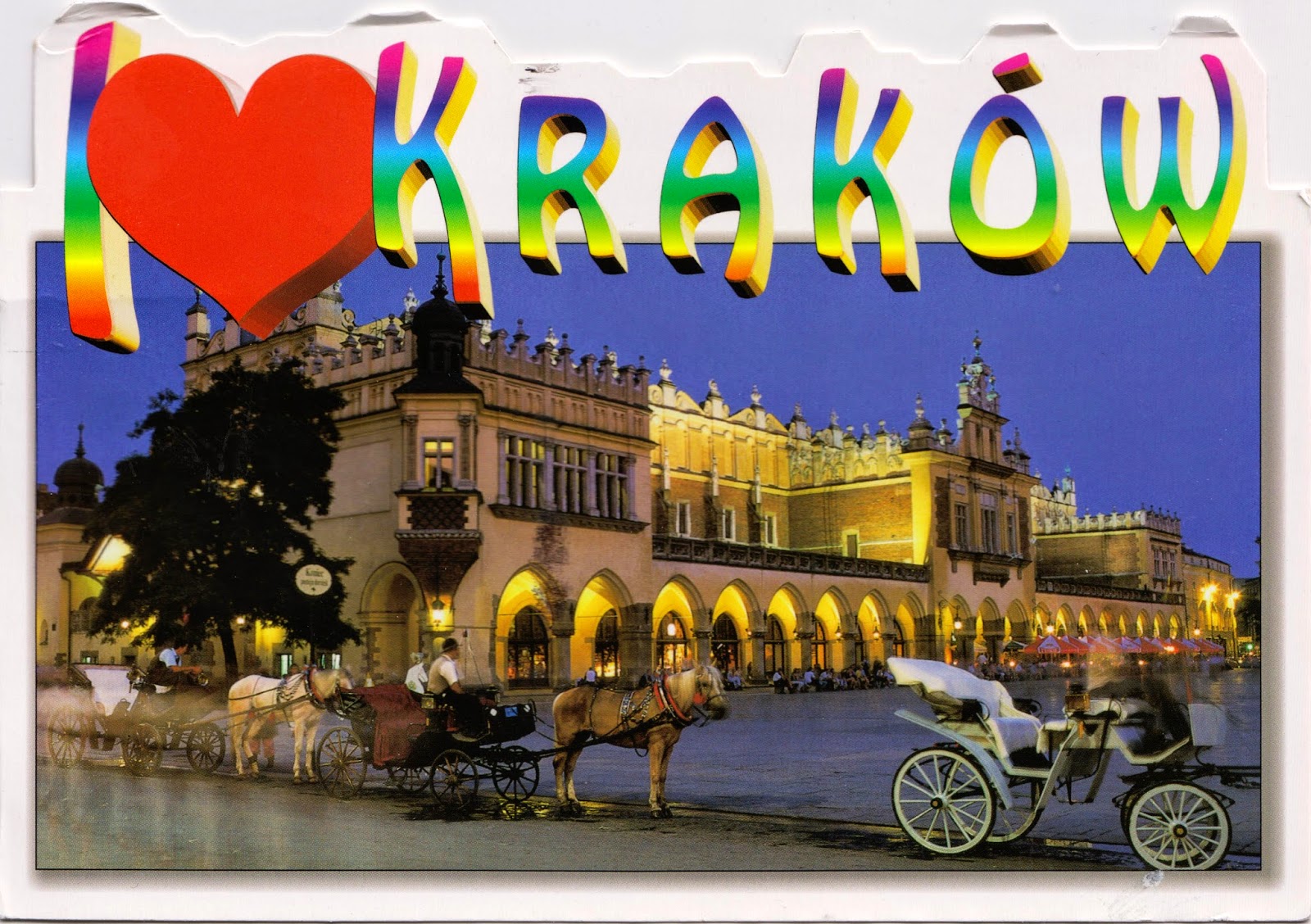
I ♥ Kraków


Postcard PL-1034007 was a shaped card showing the Renaissance Cloth Hall at the Main Square in the Old Town of Kraków, Poland.

Located on the Vistula River, Kraków is the second largest and one of the oldest cities in Poland, dating back to the 7th century. Historically an early trade center and once the capital of Poland from 1038 to 1569, it is one of the most important Polish academic, cultural, and artistic centers and  economic hubs, with 8 million people living within 100 kilometers or 62 miles of the city center.

At 40,000 square meters or 430,000 square feet, its Main Square is the largest medieval town square in Europe, also one of the best public spaces in Europe due to its lively street life, surrounded by historic townhouses, palaces and churches. Rebuilt in 1555 in the Renaissance style, the Cloth Hall is the dominated feature of the Main Square as one of the city's most recognizable icons. Once a meeting place for traveling merchants who met there to discuss business and to barter, the Cloth Hall is still used as a center of commerce. As a culture venue, it has received many distinguished guests and dignitaries, hosted receptions and performances, and housed the Sukiennice Museum division of the National Museum on its upper floor.

The Kraków Old Town was recognized as a UNESCO World Heritage Site in 1978.

Thursday, March 19, 2015

Saint Basil's Cathedral, Moscow, Russia


RU-3443849 came from Russia with two postcards showing various landmarks in Moscow, one of which features Saint Basil's Cathedral, once a Orthodox church and now a part of the State Historical Museum in Red Square in Moscow, Russia. The building, located in immediate proximity of the Kremlin Palace, is officially known as the Cathedral of the Intercession of the Most Holy Theotokos on the Moat. Built from 1555 to 1561 on orders from Ivan the Terrible to commemorate the siege of Kazan, it was once the tallest building in Moscow until the completion of the Ivan the Great Bell Tower in 1600. Shaped as a flame of a bonfire, the Cathedral has a unique design with eight side churches surrounding around the ninth church of Intercession in the center. It was recognized as part of the Kremlin and Red Square UNESCO World Heritage Site in 1990.

Tuesday, January 20, 2015

University of Virginia in Charlottesville


Postcard US-3149031 to China shows the lawn at the University of Virginia in Charlottesville, Virginia. Established in 1819, the central quadrangle was designed by Thomas Jefferson. He planned the two story Pavilions as homes for professors, who lived upstairs and taught downstairs. Between them are rows of single rooms where students have lived since 1825. It's part of the Monticello and the University of Virginia in Charlottesville World Heritage Site recognized by UNESCO in 1987.

Update: In his State of Union address to the nation this evening, President Obama challenged the Congress to make two-year community college free under certain conditions, and to overhaul tax codes to shift benefits away from wealthy Americans in order to offer tax credits for college. As a public and state-affiliated institution, the University of Virginia in Charlottesville offers a good example on what investment on higher education can do for the nation by its association with 7 Nobel Laureates, 7 NASA astronauts, 7 Marshall Scholars, 4 Churchill Scholars, 29 Truman Scholars, and 50 Rhodes Scholars,

Tuesday, December 16, 2014

Yakushi-ji, Nara, Japan


Postcard JP-616307 from Japan shows Yakushi-ji (薬師寺) in Nara, one of the most famous imperial and ancient Buddhist temples in Japan. The temple was established in 680 C.E. (the Common Era) and was name after Yakushi Nyorai (藥師琉璃光如來), "the Medicine Buddha", who was one of first Buddhist Deities to arrive in Japan from China. Yakushi-ji is one of the eight places that are collectively recognized as the "Historic Monuments of Ancient Nara" World Heritage Site by UNESCO in 1998.

Sunday, November 23, 2014

Fujian Tulou


Postcard CN-1464982 from China shows a Fujian Tulou (福建土楼),  the most representative and best preserved example of the earthen houses in China. Located in the mountainous regions in Fujian Province, those houses exemplify a particular combination of communal living and defensive functions, with a harmonious building relationship with the environment. A group of 46 earthen houses built between the 15th and 20th centuries was recognized as a UNESCO World Heritage Site in 2008.

Fujian Tulou reminds me the elevated pit houses, pueblos, and cliff dwellings that Ancient Pueblo peoples built in the present-day Four Corners area in the United States.

Tuesday, November 18, 2014

Latvia Celebrates Independence Day


96 years ago, Latvia declared independence from Russia on November 18, 1918 in the immediate aftermath of World War I. The red and white flag was chosen as the Latvian National Flag.

In the following years, Latvia was captured and declared a Soviet Socialist Republic in 1919; recognized as an independent nation again in 1921; occupied first by the Soviet Union and then by Nazi Germany under the covert Molotov-Ribbentrop Pact between the Soviet Union and Nazi Germany in 1939; and eventually by the Soviet Union again after World War II.

Earlier this year marks the 25th anniversary of the Baltic Way event when significant peaceful protests from the three Baltic countries - Latvia, Lithunaia, and Estonia rallied against oppression under the Soviet Union in 1989. Latvia regained its independence following the dissolution of the Soviet Union.

Postcard LV-79087 from Latvia shows the cityscape of Riga, the capital of Latvia. Its Art Nouveau center was recognized as a UNESCO World Heritage Site in 1991.

Thursday, November 6, 2014

Bern, Switzerland


Postcard CH-214914 from Switzerland shows a satellite image of the city of Bern,  the Bundesstadt or de facto capital of Switzerland. With a population of 137,980 as of 2013, Bern is the 4th most populous city in Switzerland with its metropolitan area of more than  660,000 residents.

The insert on the right shows an aerial view of the historic old town in the center of Bern, on the west of the boundaries of the peninsula surrounded by the River Aare, where the river forms the renowned “Aare loop” and the water temperature never reaches more than 20°C or 68°F. The medieval city center was recognized as a UNESCO Cultural World Heritage Site in 1983.

Wednesday, October 22, 2014

Love Locks and the Pont des Arts


Postcard SG-157009 from Singapore shows a loving couple at the Pont des Arts, a pedestrian bridge which crosses the River Seine in Paris, France. It was first built between 1802 and 1804, under the reign of Napoleon I, at the present location as the first metal bridge in Paris. Listed as a National Historic Monument on March 17, 1975, the Pont des Arts is also part of the World Heritage Site "Banks of the Seine" in Paris, recognized by UNESCO in 1991.

The bridge has been known for those love locks attached to the railing since 2008. Couples engrave their names on the padlocks and throw the keys into the Seine river after locking them in place as a gesture of committed love. However, as the number of locks became overwhelming, city officials in Paris started to remove some lock-laden railings and replace them with special glass panels in September, 2014. The Mayor's Office in Paris launched a #lovewithoutlocks campaign to encourage people to take "selfies" instead of leaving love locks.

Wednesday, October 8, 2014

Mount Nemrut, Adıyaman, Turkey


Postcard TR-197954 from Turkey shows Mount Nemrut near Adıyaman in southeastern Turkey, a presumed royal tomb site built by King Antiochus I Theos of Commagene in 62 B.C. At its 2,134 m or 7,001 ft summit, there are a number of large statues with their heads separated and scattered throughout the site. Mount Nemrut was recognized as a UNESCO World Heritage Site in 1987.

Friday, July 25, 2014

Piazza dei Miracoli


Postcard IT-278165 from Italy shows the Piazza dei Miracoli, which means "Square of Miracles", a wide walled area located in Pisa, Tuscany, Italy. It is recognized for it's important role in European medieval art and architecture. Owned by the Catholic Church, the square is dominated by the Pisa Cathedral, the Pisa Baptistry, the Leaning Tower of Pisa, and the Camposanto Monumentale (Monumental Cemetery). It also hosts the New Hospital of the Holy Spirit that houses the Sinopias Museum and the Cathedral Museum. The Piazza dei Miracoli became a UNESCO World Heritage Site in 1987.

Tuesday, July 22, 2014

Cape Reinga, New Zealand

Postcard NZ-107618 from New Zealand shows a sunset view of Cape Reinga, the northwesternmost tip of the Aupouri Peninsula, at the northern end of the North Island of New Zealand. In native Māori culture, the cape is where the spirits of the dead leap into the underworld.


Cape Reinga is on the tentative list of UNESCO's World Heritage Site, waiting to receive formal recognition. The cape is already a favorite tourist attraction, receiving over 120,000 visitors per year and around 1,300 cars per day during peak season. However, similar to the Key West bouy, the cape is not the northernmost point of the North Island, and thus, of mainland New Zealand, contrary to the common belief. North Cape's Surville Cliffs, 30 kilometers or 18.6 miles east of Cape Reinga, are slightly further north.

Tuesday, May 20, 2014

West Lake Cultural Landscape of Hangzhou


Postcard CN-1291364 from China shows West Lake (西湖), a freshwater lake in Hangzhou, eastern China, that has inspired famous poets, scholars and artists since the 9th century. There are numerous temples, pagodas, pavilions, gardens and ornamental trees, as well as causeways and artificial islands.

It was inscribed on the UNESCO’s World Heritage List in 2011 as the West Lake Cultural Landscape of Hangzhou, comprising the West Lake and the hills surrounding its three sides, described as having "influenced garden design in the rest of China as well as Japan and Korea over the centuries" and reflecting "an idealized fusion between humans and nature."

Tuesday, May 6, 2014

Moon Over the East Temple in Kyoto


Postcard JP-531477 from Japan shows the East Temple (東寺)  in Kyoto, Japan. It is famous for the five-story pagoda with layered tower, dated from 796, as the tallest wooden tower in Japan at 54.8 meters. The pagoda has been a symbol of Kyoto. It is part of the "Historic Monuments of Ancient Kyoto" World Heritage Site recognized by UNESCO.

Saturday, April 12, 2014

Dolomiti, Italy

Postcard IT-255128 from Italy shows the Dolomite mountain ranges in northeastern Italy. According to Wikipedia, those mountain ranges "form a part of Southern Limestone Alps and extend from the River Adige in the west to the Piave Valley (Pieve di Cadore) in the east. The northern and southern borders are defined by the Puster Valley and the Sugana Valley (Val Sugana). The Dolomites are nearly equally shared between the provinces of Belluno, South Tyrol and Trentino." They are home to many regional parks. In 2009, the Dolomites were recognized as a UNESCO World Heritage Site.

Friday, April 4, 2014

A Cat Peering Outside


Outgoing postcard US-2680023 to New Zealand shows a National Geographic photo of a cat, next to a blue door, peering out of the window of an adobe house at Taos Pueblo in New Mexico. Taos Pueblo is a Native American community with a population of 1264 in the 2000 census. It was designated as a World Heritage Site by UNESCO in 1992 and a National Historic Landmark in 1960.

Copyright by Ira Block/National Geographic Stock. The postcard was created By National Geographic and can be purchased at Zazzle.